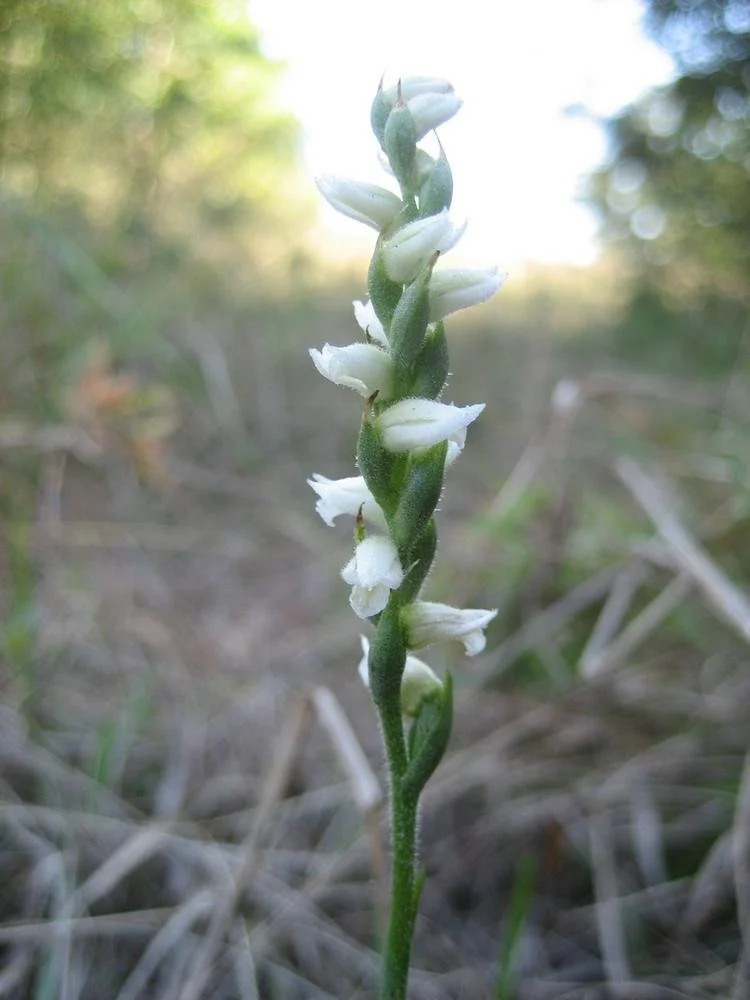
Navasota Lady Tresses
The Navasota Ladies Tresses (NLT) orchid has a life of a princess constrained by difficult circumstances due to a shrinking habitat and changing conditions in Texas. It’s on the national and state’s endangered list for plants. NLT is endemic to Texas, due to her royalty, highway 290’s construction had to be frozen until contracted negotiations could be arranged for rerouting it around her habitat. It has a security team around it making it harder to obtain an appointment with than the president!!! Due to the nature of an endangered plant, it’s in a protected environment, allowing for a habitat to nurture the growth of this terrestrial orchid.
Its named for a horizontal, white flower that spirals counterclockwise around the upper 5 cm of its stalk. The leaves are only 3 inches in length and are the first part of the plants growth known as a basel rosette, appearing in February through March. Later in its development, after the leaves have died, the stalk begins its growth and flowers are blooming in September through October. Adorned with a green stripped center and a lacy lip help define its difference from other lady tress orchids. Bees pollinate the flower and it needs mycorrhizal fungi to survive after seed dispersal and germination.
In order to illustrate this endangered plant I received help and photographs from a team of people. I’d like to thank Joe Liggio for helping me with orchid anatomy and directing me to the A&M crew. At A&M, the Dept. of Ecology and Conservation Biology, William Rogers,Ph.D, Ben Patterson, biologist and the Twin Oaks Landfill Deed Restricted Area for providing photographs and measurements.
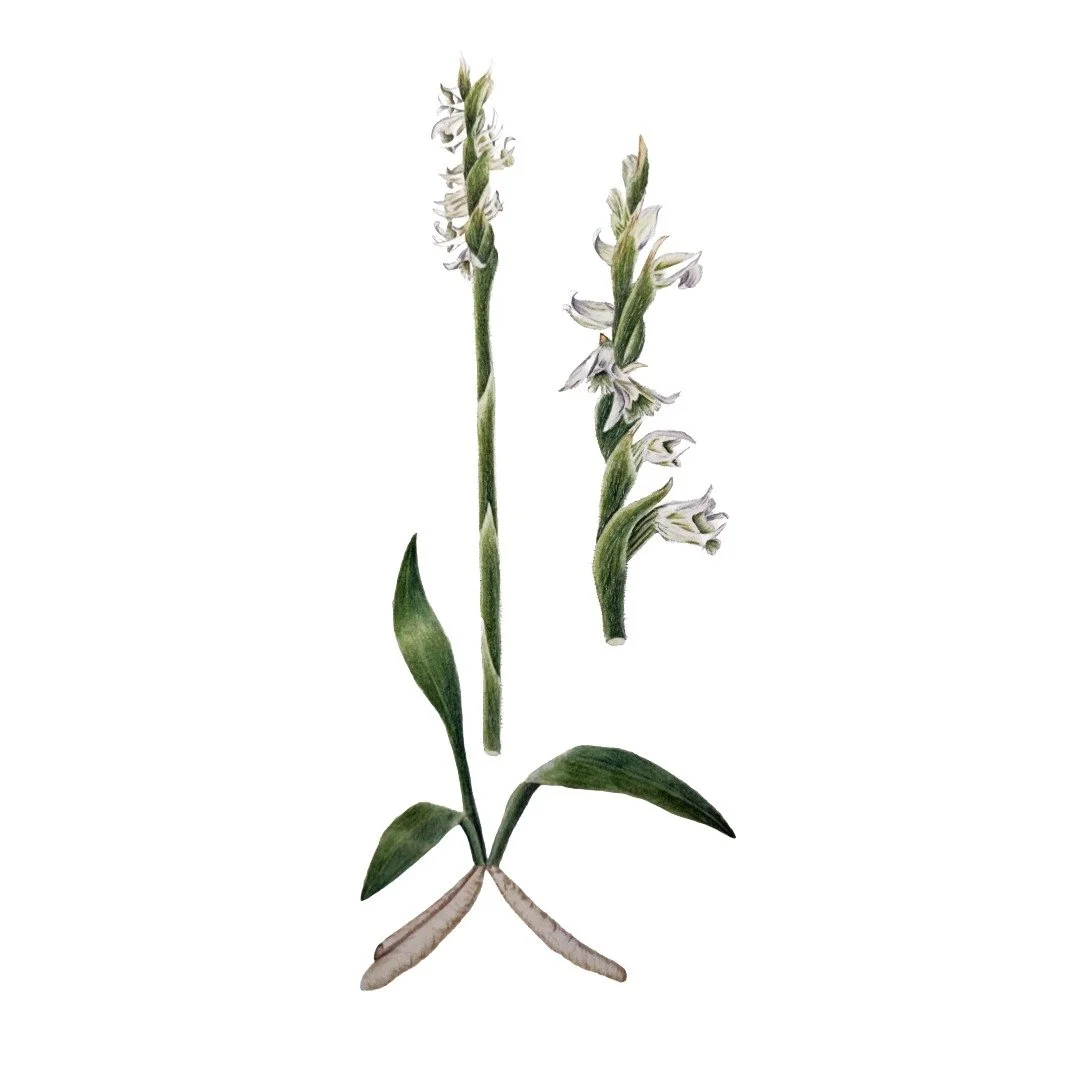
My botanical illustration of the Navasota Lady Tresses.
Photograph below, compliments of TX A&M Dept of Ecology and landowners on which the NLT grows.